
Tenaz Energy

Active
COVERAGE RECORD
Updated April 2026

Analysis Log

31 Library articles · Aug 2021 – Apr 2026
LIBRARY · APR 2026 · $59.89

The Fog of War

Since last month's note here, CIBC launched coverage on TNZ with an $80 share price target using a price deck that is much, much lower than current TTF strip pricing. My comments regarding TNZ remain the same. The company has higher projected production growth, lower declines, a longer reserve life, higher netbacks, and a higher projected free cash flow yield than almost all of its peers. In that light, the fact that big banks are noticing now is rational and reasonable and it highlights the fact that TNZ has "graduated" to a completely different market profile. The sheer size of the position has had me reducing it gradually, but it is still, by far, my largest holding. TNZ is the best play on European gas prices in the market and with the LNG shortage about to bite – it is now mathematically implausible ↗ for Europe to meet its gas storage goals for next winter, at any price. I can't think of a company that is better positioned on the European energy scene. Every once in a while, the idea of windfall energy taxes surfaces in Europe, but I don't spend a lot of time worrying about that for a few reasons:

  1. it's out of my control,
  2. it would mean that TNZ would be earning super-normal profits, and
  3. the $70-80 share price targets published by the brokerages that cover TNZ are not based on the currently elevated European natural gas futures prices in the first place.

TNZ remains a cornerstone investment for me and I'm quite relaxed about it. You won't see many situations like this in your whole investing career, so savour it – and think about how you might recognize an opportunity like it in the future.
LIBRARY · MAR 2026 · $61.35

Batter Up!

In the second week of March, Tenaz reported its annual results for 2025. There were no surprises in there, aside from an exploration discovery offshore Netherlands that tested at 23 mmcf/d with 300 bbls/d of associated condensate (that well was not in any reserve category as of the end of 2025). The company reported record cash flow, record reserves, record production, and the beginnings of the quantification of its large contingent and prospective resource portfolio… all as expected. I can't find a thing about TNZ that I don't like right now. Tenaz is smack in the middle of the European gas market with 90% of its corporate production volumes priced in TTF (TTF is currently at ~US$17/mcf, versus $3.15/mcf in the U.S.), making it the premier "pure play" on that market. With the LNG crisis expected to persist for at least another month, gas importers will be running flat out to try to catch up for lost volumes, which could be a protracted process. I don't have a lot to say about TNZ, other than that it still trades at a very average multiple on prices decks derived before the LNG/TTF price spike. Typically, premium multiples are assigned to companies with superior returns on capital, higher growth rates, deeper inventories, higher margins, and lower declines… TNZ has all of those. The street-high price target on TNZ is now $70/share which excludes the impact of the current elevated price levels, assigns no value for future discoveries, or any M&A upside potential. Obviously TNZ has come a long way. Naturally profit taking after a run like this is expected, but that's all part of the natural evolution of the story. TNZ's size and liquidity are increasing its profile and suitability for larger funds and indexes alike, which is ushering in the transfer of stock from retail hands to institutional ones. My hat is off to Tony Marino and the whole team at Tenaz.

Operationally, TNZ will be active on the NOBV and GEMS asset packages this year. The first well at the GEMS asset continues to flow at around 75 mmcf/d and a second well has been drilled, encountering a slightly thicker than expected gross gas column with testing and/or tie-in expected in Q2.

LIBRARY · FEB 2026 · $45.43

Focusing on Value in Volatile Times

After National Bank took its price target on TNZ to $52/share in January, it raised it even higher – to $66 – not long after. Beacon Securities and Haywood then took their price targets to $56 and $55 respectively as they too looked forward to 2027 numbers in generating their 12-month price targets. None of those targets include anything for the ever-present potential for future M&A;, but TNZ stands on its own as a high-growth story on its existing asset base already, so let's just call additional M&A; potential a "free embedded option". Even at those price target levels, TNZ would still be trading at a discount multiple to most of its domestic peers and sometimes you have to ask why that would be the case. Why should a company with superior netbacks, superior per share reserves and production growth, and superior decline rates trade at discount multiple? It's some food for thought.

Tenaz will report its annual results, year-end reserves, and provide an operational update before my next note (TNZ will report around the second week of March), so I'm sure a lot of readers will be keenly focused on that. Personally, I'm going to view the financial results and reserves as a backwards-looking snapshot in time, but the operational update will have my attention as this is when we get to start to see what TNZ can really do with the NOBV/TEN and GEMS assets. 2026 and 2027 will see substantial production and cash flow growth as the company executes on the "optimize and exploit" parts of its business plan.

TNZ has been on a tear lately and it has been an absolute grand slam for myself, shareholders, and management alike. Even after some tactical trimming, TNZ is still my largest position by far and I don't lose any sleep over it (for full disclosure, my own portfolio weighting is well in excess of what the Circle's 5-pie-piece allocation lens rating would suggest). Production, cash flow, and reserves per share are all set to increase substantially over the next couple of years and TNZ is now at a market cap level where it will start attracting a whole new level of institutional ownership and passive ETF buying. Its near pure-play status with respect to European natural gas makes TNZ a unique vehicle and its free cash-flow generation going forward should set the stage for an eventual dividend, but all in due course. For now, it's just steady as she goes as awareness of the story continues to spread.

LIBRARY · DEC 2025 · $23.15

The Art of Doing Nothing

I think that the prospect of a peace deal with Russia, combined with "what have you done for me lately" syndrome are what have driven a modest correction in TNZ's share price from its recent all-time highs. Dutch TTF gas prices are now essentially at the same levels as the cost of landed ship-borne LNG, so if I was going to call a bottom in TTF prices it would be right around here.

Even with a Russian peace deal, Russian gas isn't coming back via overland routes to Europe any time soon, so I am sanguine about TNZ's gas price risk. Indeed, I like the look of European gas quite a bit given that landed LNG is the marginal molecule there.

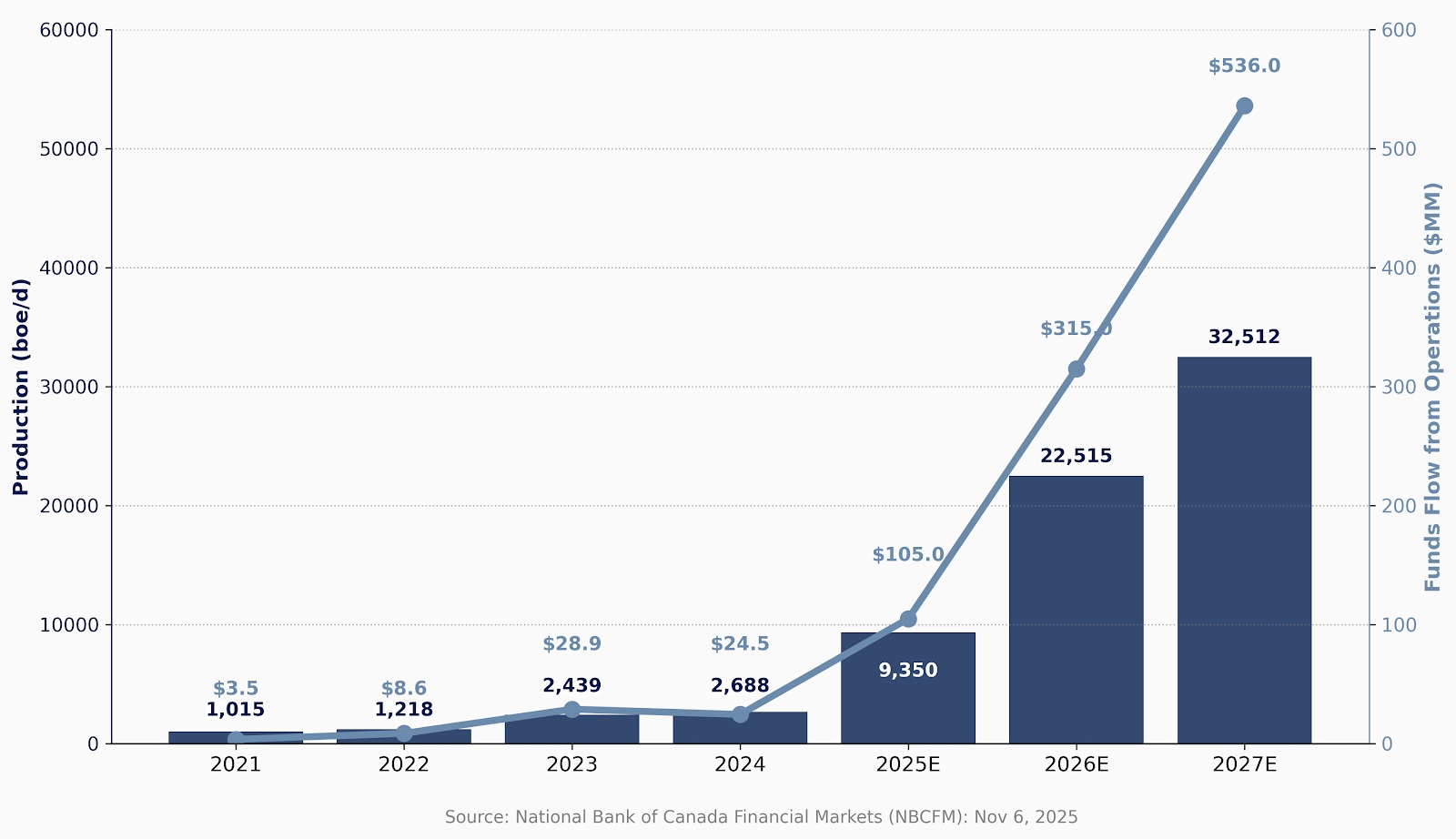
Meanwhile, TNZ has the highest organic production-per-share growth of any energy company that I'm aware of (around a 35-40% CAGR from exit 2025 production rates for both 2026 and 2027) and it trades cheaply on NAV and EV/CF multiples, with strong free cash flow. The M&A; upside optionality is ever-present – but not required here for share price appreciation – and I think that the next leg up for TNZ will simply be driven by increased institutional investor awareness.

TNZ Chart

TNZ will be at the NBF Energy Conference in January, followed by the CIBC Whistler conference in February… I expect money managers will come out of those conferences with a very favourable impression of the value proposition that is on the table here.

NBF recently mentioned that their analyst has TNZ trading at ~1.6x EV/DACF (DACF = debt adjusted cash flow) on 2027 numbers, and given that analysts will look towards 2027 projections to derive their 12-month price targets when the calendar turns over to 2026 next month, TNZ stands out as highly undervalued relative to the rest of the sector.

Patience is a virtue with this one.

LIBRARY · NOV 2025 · $25.34

Building a Stable

The thoroughbred in its prime. With two deals under its belt, Tenaz has already won two of the three major races needed to capture the Triple Crown from my perspective. I have nothing to add here. TNZ is a cornerstone holding for me and this horse has a lot more racing to do.

LIBRARY · OCT 2025 · $25.51

Beginnings

Many of you will already own Tenaz as well and will know the thesis like the back of your hand. For those who are not familiar, TNZ is a small-cap international energy company that is growing through a combination of asset acquisition and subsequent exploitation/optimization. The company has A+ management and staff who have a laser-sharp focus of building per-share value for its shareholders. This is not a hokey mission statement for the company, it is a firm-wide resolve. The company has current run-rate production of approximately 16,200 boepd, the vast majority of which is composed of gas production offshore of the Netherlands and, recently, Germany. TNZ has been a core holding of mine for years and the company's execution to date has been superb. This quarter, the company will start drilling wells in the North Sea for the first time, with a focus on known accumulations and low-risk step out/near-field exploration targets. Production next year is expected to grow to something in the region of 22,000-23,000 boepd and the company is expected to generate significant free cash flow going forward. Asset acquisition is expected to continue as the company grows towards its goal of becoming a 50,000+ boepd producer. TNZ trades at a low-to-average cash flow multiple relative to its peers and at a significant discount to its 2P (proven-plus probable) net asset value of nearly $50 per share. Not all 2P values are created equal in this sector, but TNZ's 2P value is of high quality. Because of TNZ's pure-play status when it comes to exposure to European gas markets, I am particularly intrigued by the approach of winter this year. Europe has skated through the last couple of winters without huge price spikes, but with inventories modest at best – and with volatile LNG as its marginal supplier – a cold winter could focus attention on TNZ in a hurry. TNZ has only about 28 million shares outstanding, which is what provides the kind of per-share torque that investors have enjoyed thus far. Additional value capture through the drill bit and/or M&A; activity should continue to benefit shareholders due to this tight capital structure.

LIBRARY* · OCT 2021

If Oil and Gas Stocks are the New Tobacco -- Welcome to Flavour Country

© 2025 THE CIRCLE